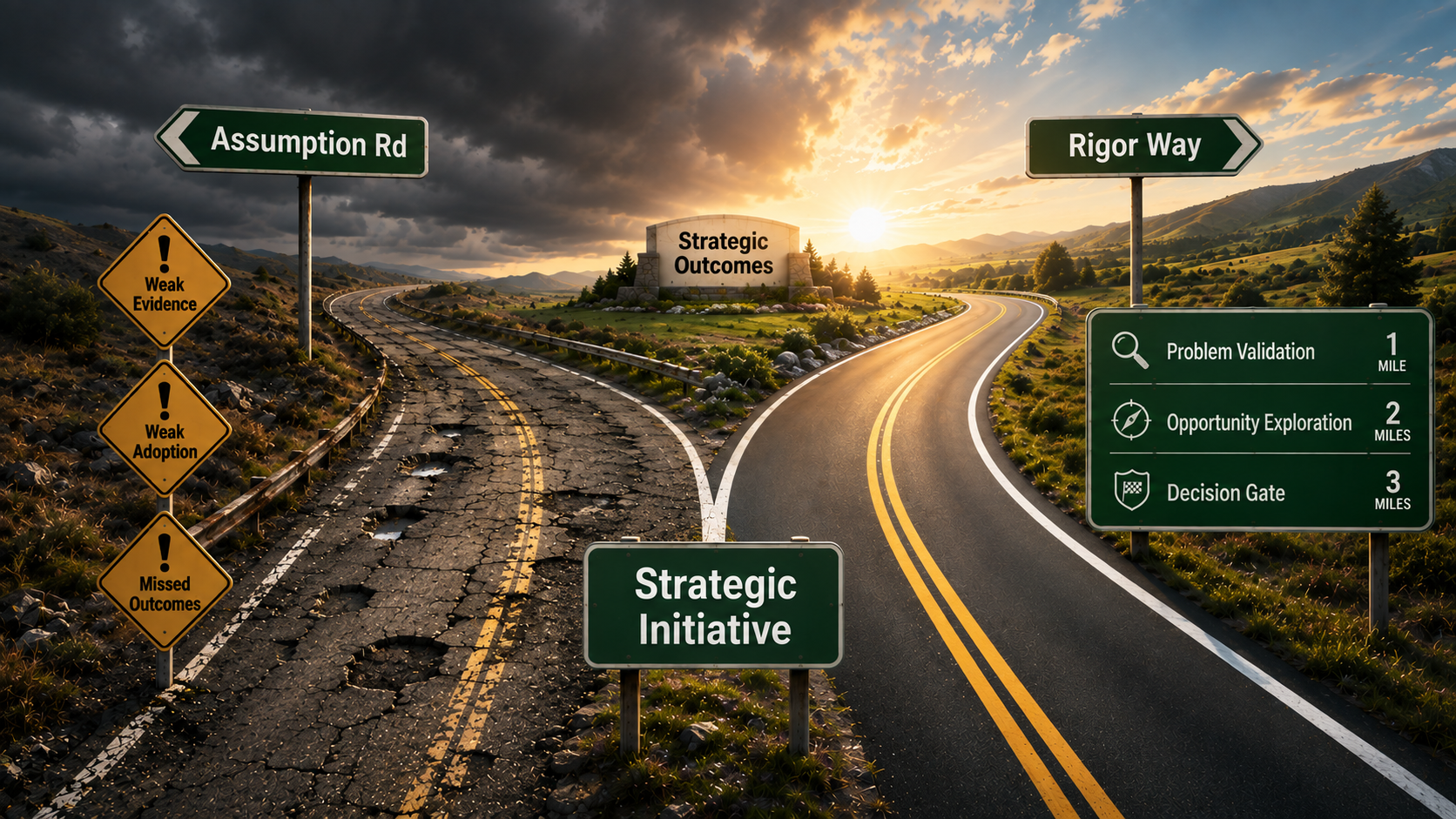
Have you experienced this?
An initiative receives leadership approval and significant funding. A team is assembled. Consultants may be brought in. New technology is purchased. Employees are expected to adopt new ways of working.
Months later, the expected outcomes aren’t materializing.
Costs have exceeded projections. The workforce isn’t fully engaged. Adoption is lower than expected. Customers and stakeholders aren’t experiencing the anticipated value. Leadership begins questioning whether the transformation is working.
Attention naturally turns to execution. Stakeholders question:
- Was the initiative poorly managed?
- Was the change strategy ineffective?
- Did the technology underperform?
- Did the organization underestimate implementation complexity?
While these are important questions turning focus to execution, there is another question said in silence that will eventually surface to the forefront: “Did we fund the right initiative in the first place?”
Organizations invest much time, energy and resources to execute on a strategic initiative. Unfortunately, this does not prevent initiatives from failing to meet expected outcomes. But what if the right amount of rigor took place before the decision was made to execute? Rigor that answers:
Was the problem poorly defined?
Was the expected value based on assumptions that were not fully validated?
Did stakeholders view the problem with the same urgency as leadership?
Was organizational readiness overestimated?
If the answer to any of these questions is yes, better execution alone would not have solved the issue. The weakness existed before execution began and could have been identified before committing significant time, funding, workforce capacity, and leadership attention.
This is where Decision Rigor becomes essential. Decision Rigor provides a disciplined approach for determining whether a proposed initiative deserves organizational investment before major resources are committed.
What is Decision Rigor?
Decision Rigor in this context is the disciplined evaluation of a proposed strategic initiative before significant resources are committed. It is the process of determining whether an initiative is sufficiently defined, evidence-supported, strategically aligned, and capable of delivering meaningful organizational value. Rather than accepting an initiative at face value, Decision Rigor challenges the underlying problem, tests key assumptions, evaluates available evidence, and determines whether the proposed initiative is worthy of investment.
Organizations often apply rigor to business cases, project plans, implementation strategies, and governance reviews. Decision Rigor shifts that discipline further upstream by asking whether the organization has enough confidence to move forward in the first place. It is less concerned with how an initiative will be executed and more concerned with whether it deserves to be executed.
This changes the conversation. Instead of beginning with, “Can we execute this?” leaders first ask, “Does this initiative deserve to be executed?” That subtle shift in thinking can fundamentally change how organizations allocate time, funding, workforce capacity, and leadership attention.
Decision Rigor Starts with the Problem
Every strategic initiative is intended to solve a problem or capitalize on an opportunity. Yet organizations often devote more time to evaluating proposed solutions than validating whether they fully understand the problem those solutions are intended to address.
This is where Decision Rigor begins.
Before discussing technology, staffing, budgets, implementation plans, or return on investment, leaders should have confidence that the underlying problem is clearly defined, strategically significant, and supported by evidence. Without that confidence, organizations risk investing in initiatives that address symptoms rather than root causes.
Solution-first thinking is one of the most common barriers to sound strategic decision-making. Once a preferred solution gains momentum, the conversation often shifts from understanding the problem to justifying the solution. Evidence is gathered to support the initiative rather than determine whether it addresses the right problem.
Decision Rigor challenges that pattern by requiring leaders to pause before committing resources. A request for a new technology platform may reveal an underlying process issue. A proposal to increase staffing may expose workflow inefficiencies. An AI initiative may begin with enthusiasm for the technology while the actual business problem remains poorly defined.
Before evaluating what to fund, leaders should be able to answer a few fundamental questions:
- What problem are we actually trying to solve?
- Who is affected and how significant is the impact?
- What outcome are we trying to achieve?
- What evidence confirms this problem exists?
Only after those questions are answered with confidence should the conversation shift toward evaluating potential solutions.
Decision Rigor Evaluates the Opportunity
Understanding the problem is only the first step. Decision Rigor also requires leaders to determine whether addressing that problem justifies a strategic initiative.
Not every problem warrants a major organizational investment. Organizations operate with finite funding, workforce capacity, leadership attention, and tolerance for change. While a problem may be legitimate, it may not be significant enough to justify committing strategic resources.
This requires leaders to move beyond asking, “Is this a real problem?” and begin asking, “Is this the right opportunity to pursue?”
Decision Rigor evaluates whether solving the problem aligns with organizational strategy, creates meaningful value, benefits the right stakeholders, and justifies the investment when compared with competing priorities. It also considers the consequences of taking no action, ensuring that urgency is supported by evidence rather than perception.
An initiative can address a legitimate problem and still represent the wrong strategic investment. That distinction becomes increasingly important as organizations compete for limited resources across multiple strategic priorities.
The objective is not simply to identify good ideas, but to identify the initiatives most deserving of organizational resources.
Decision Rigor Challenges Assumptions
Every strategic initiative is built on assumptions. Organizations assume customers will adopt the solution, employees will embrace new ways of working, technology will perform as expected, anticipated benefits will be realized, and sufficient capacity exists to execute successfully.
There is nothing inherently wrong with assumptions. Strategic decisions will always involve uncertainty, and leaders are often required to make decisions before every variable can be validated.
The problem arises when assumptions are accepted as facts.
Decision Rigor requires organizations to identify and challenge the assumptions that underpin a proposed initiative before significant resources are committed. Some assumptions will prove accurate. Others may expose gaps in understanding that fundamentally change the initiative or reveal that additional validation is needed before moving forward.
This is where evidence becomes essential. Leaders should be able to distinguish between what is supported by evidence, what is based on informed judgment, and what remains uncertain.
Questions such as What do we know? What do we believe? What still needs to be validated? help expose hidden risk and focus attention on the assumptions most critical to success.
The objective is not to eliminate uncertainty. It is to better understand uncertainty before committing significant time, funding, workforce capacity, and leadership attention.
Decision Rigor in Opportunity Exploration
Identifying a worthwhile opportunity does not automatically reveal the best path forward. Before organizations commit to a specific solution, they should invest time exploring the opportunity from multiple perspectives.
Exploration deepens understanding of the problem by validating stakeholder needs, assessing the operational environment, examining previous efforts, evaluating market and regulatory conditions, and identifying factors that could influence success. It also provides an opportunity to challenge initial assumptions with new evidence before they become embedded in an approved initiative.
Questions such as What do stakeholders actually need? What has the organization learned from similar efforts? Is there sufficient demand? Is the organization ready? What evidence strengthens or weakens the original assumptions? help leaders determine whether additional refinement is needed before moving forward.
Exploration may strengthen confidence in an initiative. It may also reveal that the initiative should be modified, delayed, or approached differently.
Both are valuable outcomes.
Discovering that an initiative needs refinement before commitment is not a failure of execution. It is evidence that Decision Rigor is working.
Decision Rigor Requires Meaningful Decision Gates
Decision Rigor is only valuable if it influences decisions.
Too often, governance processes become approval processes. An initiative enters with the expectation that it will eventually emerge approved. Reviews may adjust budgets, modify schedules, or identify implementation risks, but they rarely challenge whether the initiative should continue at all.
Meaningful decision gates create intentional points where leaders evaluate whether the available evidence justifies additional investment. Rather than assuming every initiative progresses, Decision Rigor recognizes three legitimate outcomes:
Advance. The initiative demonstrates sufficient evidence, strategic alignment, and organizational value to justify additional investment.
Refine. The opportunity appears worthwhile, but important questions remain unanswered and additional exploration or validation is required.
Do Not Proceed or Fail Fast! The evidence, expected value, strategic alignment, feasibility, or organizational readiness does not justify committing additional resources.
Organizations often measure value by what they successfully implement.
Decision Rigor also recognizes the value of what organizations choose not to implement.
Stopping a weak initiative before major resources are committed preserves funding, workforce capacity, leadership attention, and organizational trust for opportunities with greater strategic value.
AI Can Strengthen Decision Rigor
Decision Rigor requires leaders to evaluate fragmented information, competing stakeholder perspectives, hidden assumptions, uncertain evidence, and complex organizational environments. As the amount of available information grows, maintaining consistency across strategic decisions becomes increasingly difficult.
This is where AI-assisted Decision Intelligence can strengthen the decision-making process.
AI can help structure ambiguous initiative concepts, synthesize evidence from multiple sources, identify conflicting information, surface hidden assumptions, compare stakeholder perspectives, expose evidence gaps, and provide transparent rationale that supports evaluation. It can also improve consistency by enabling initiatives to be evaluated using the same disciplined criteria rather than allowing each proposal to be judged using different standards.
AI strengthens the quality of information, analysis, and reasoning available to decision-makers. Leaders apply judgment, consider organizational context, accept accountability, and ultimately determine whether an initiative deserves additional investment.
Rigor Before Resources
Organizations will always need strong execution capabilities. Project management matters. Change management matters. Governance matters. Technology implementation matters. But each of these disciplines operates after a more consequential decision has already been made.
Does this initiative deserve to be executed?
Before committing significant time, funding, workforce capacity, and leadership attention, leaders should have confidence that:
- The problem is clearly understood.
- The opportunity is worthy of investment.
- The initiative aligns with organizational strategy.
- Stakeholders will experience meaningful value.
- The supporting evidence is sufficient.
- Critical assumptions have been challenged.
- Risks and uncertainties are understood.
- The organization is positioned to succeed.
When those conditions are not sufficiently established, leaders should be willing to refine the initiative or decide not to proceed. This is a demonstration of Decision Rigor.
It’s time to apply Decision Rigor to your process of determining which initiatives deserve to be executed in the first place.