Organizations are under constant pressure to transform. Transformation is necessary as new technologies emerge, customer expectations change and competitors evolve. The need is clear and understood. What’s also understood is that transformation is hard.
An organization can have the right strategy and still struggle to execute. It can invest in the best technology and fail to realize the value of the investment. It can employ talented people and still find itself unable to meet growing customer demand.
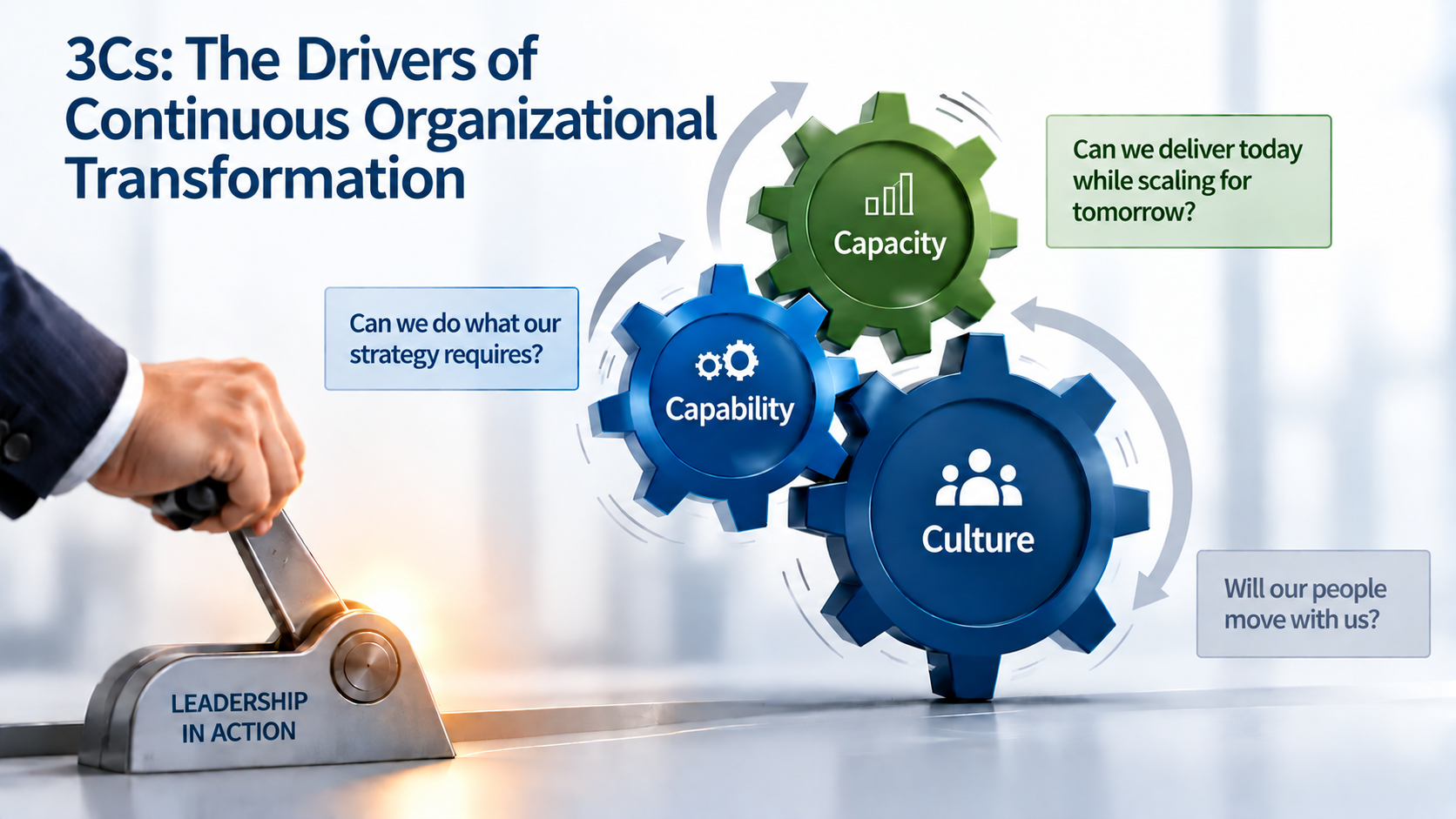
Over the course of my career, I’ve had the opportunity to be part of, lead, and advise organizations through transformation efforts. I have found that there are three interconnected dimensions that are always at the core of transformation—Culture, Capability and Capacity. I call these the 3Cs of Transformation. When the 3Cs are aligned and intentionally strengthened together, organizations are better positioned for successful transformation. Therefore, it’s important to understand the 3Cs as a way of understanding, evaluating and positioning an organization to move from today to where it needs to be tomorrow.
Culture: Will our people move with us?
Culture is most important, as it is directly tied to people. People transform organizations.
Strategies, processes, organizational structures, and technologies can all be redesigned. But ultimately, people must adopt new behaviors, make different decisions, learn new skills, and sometimes let go of practices that have made them successful in the past. In my experience, driving behavior change comes with a high degree of leadership tension. How do leaders convince people to do something different from what they know currently works? Convincing starts with trust.
“I trust my organization and I’m excited about the future.” When your employees are thinking this way and saying it out loud, they will follow your lead through transformation. People feel valued. They understand where the organization is going, who the customers are, what those customers value, and how their individual contributions connect to the organization’s larger purpose. In this winning culture, employees are more likely to see themselves as participants in transformation rather than recipients of it.
As an example, consider two organizations implementing the same AI technology.
In the first organization, leaders explain why the technology is necessary, connect it to customer needs, involve employees in shaping how the technology will be used, invest in training, listen to concerns, and demonstrate how the technology adoption supports the organization’s vision.
In the second organization, leaders announce the AI technology adoption as a requirement, establish an implementation deadline, provide basic training, and measure success primarily by whether the system was deployed.
Both organizations successfully roll out the technology. But only one is likely to achieve full adoption.
Why?
Leaders in the first organization deliberately communicated and demonstrated the value of the new technology to their employees. Employee concerns were addressed and were brought into the fold of implementation. The second organization mandated the adoption. Their people likely felt like the technology was forced into their work. They can’t see the value. Mandates are usually followed by resistance. Resistance creates tension that hinders genuine adoption and successful transformation.
To mitigate tension, consider these three attributes that I believe must be strong to have a transformative culture:
Communication. Communication must be deliberate, consistent and accurate. Don’t assume communication channels throughout the organization are intact. Test, evaluate and quickly get in front of miscommunication or any communication gaps. Communication gaps rarely remain empty, as they are quickly filled by assumptions and misinformation that can erode trust.
Transparency. People are more likely to embrace change when they understand the “why” behind it. Leaders should be open about what is changing, why it is necessary, what is known, and even what is still uncertain. Transparency builds trust and gives people the context needed to understand how change connects to the organization, its customers, and their work.
Empowerment. People need the ability to influence transformation. Create opportunities for employees to challenge assumptions, identify problems, offer solutions, and shape how change is implemented. The people closest to the work often see risks and opportunities leaders cannot. Empowering them turns employees from recipients of change into participants in transformation.
Communication gives people information, transparency provides context, and empowerment gives them agency. These cultural attributes influence whether people trust leadership, understand the purpose behind change, challenge outdated assumptions, collaborate across boundaries, and ultimately embrace new ways of working. These attributes are central to the organization’s transformation infrastructure.
Capability: Can we do what our strategy requires?
Willingness to change is necessary, but willingness alone is not enough. Organizations must also possess the capabilities required to execute their strategy.
I think about capability through three interconnected elements: people, process, and technology. People bring skills, knowledge, judgment, leadership, and experience. Processes translate those capabilities into repeatable ways of delivering value. Technology should enable both by helping people make better decisions, automate appropriate work, access information, collaborate, and operate more effectively. However, transformation problems often emerge when leaders focus disproportionately on one element. Focusing more on technology as the answer is a good example.
Imagine an organization facing declining customer satisfaction because services take too long to deliver. Leadership concludes that outdated technology is the problem and invests heavily in a new digital platform.
The platform works exactly as designed. Yet customer satisfaction barely changes.
Why?
The organization digitized an inefficient process.
Employees still navigate unnecessary approval layers. Decision rights remain unclear. Information moves through the organization slowly. Employees have not been given the skills or authority to resolve customer issues closer to the point of need.
The organization improved its technology without improving its underlying capability.
Contrast that with an organization that begins by examining the desired customer outcome. Leaders identify the competencies employees need, redesign the process around customer value, eliminate unnecessary steps, clarify decision authority, and then introduce technology that enables the redesigned operating model.
In this situation, technology enabled the transformation.
This distinction matters increasingly as organizations adopt artificial intelligence. Buying AI tools does not create an AI-capable organization any more than buying collaboration software creates a collaborative culture. The value will ultimately depend less on the technology an organization acquires and more on the capability it builds around it.
Capacity: Can we deliver today while scaling for tomorrow?
Capability and capacity are often treated as though they mean the same thing, but they are distinctly different. An organization can possess the capability to perform something extremely well while lacking the capacity to deliver it at the scale, speed, or consistency customers require.
Consider a cybersecurity organization with highly skilled professionals, mature processes, and excellent technology. The organization clearly possesses cybersecurity capability. But if a small team is supporting an enterprise whose security demands have tripled, the organization will likely struggle due to a lack of capacity to meet the demand. We’ve all likely experienced situations where demand has affected response times or the quality of work. Teams are highly skilled and the organization has the right technology. But demand has exhausted resources. The capability exists, but the capacity does not.
Capacity extends beyond employee headcount. It includes workforce availability, leadership bandwidth, financial resources, infrastructure, operational throughput, partnerships, and the organization’s ability to absorb additional change without degrading existing performance. Linked directly to transformation, capacity must be forward-looking and evaluated against the expected demands of the future.
An organization may have exactly enough capacity to meet today’s customer requirements and still be poorly positioned for tomorrow. Growth, new technologies, changing customer expectations, new regulations, or competitive disruption can quickly expose an organization operating with no room to grow.
As a practitioner who has built capacity and an observer who has advised organizations, I have learned that the following actions are critical for establishing future capacity needs.
Anticipate future demand. Look beyond today’s workload and ask what customers are likely to require next. Consider changes in customer expectations, growth, technology, regulation, and the broader operating environment that could alter demand.
Assess organizational readiness. Determine whether the organization has the workforce, leadership bandwidth, infrastructure, financial resources, and operational throughput needed to meet anticipated demand. Identify where current capacity could become a constraint in the future.
Create strategic headroom. Avoid designing an organization that can only handle today’s requirements. Build enough flexibility to absorb growth, disruption, new priorities, and continued transformation without degrading current performance.
These actions create building blocks for capacity. Capacity building is necessary and must be intentional when positioning for the demands of today and tomorrow.
Transformation Happens at the Intersection
The real power of the 3Cs becomes apparent when they are considered together and recognized as interdependent.
Culture creates the conditions that allow capability to grow. When people understand the organization’s direction, feel valued, and are empowered to contribute, they are more willing to learn, challenge existing practices, adopt new technologies, and find better ways of working. A strong culture creates an environment where the organization can continuously develop the people, processes, and technology needed to move forward.
Capability turns that culture into action. Skilled people, effective processes, and enabling technology give employees the means to translate the organization’s vision into results. As capabilities improve, employees are better equipped to respond to customer needs, solve problems, innovate, and deliver value. Capability provides the organization with the ability to do what its strategy and customers require.
Capacity allows those capabilities to operate at the scale and pace the organization needs. The right resources, workforce availability, leadership bandwidth, infrastructure, and operational flexibility allow the organization to apply its capabilities while continuing to respond to growth and change. Capacity creates the strategic headroom needed to invest in people, improve processes, introduce new technologies, and pursue new opportunities.
The relationship is reinforcing. Culture enables people to build and embrace new capabilities. Those capabilities allow the organization to create greater value. Capacity provides the space and resources to apply, sustain, and continue developing them. As the organization grows and adapts, that progress can further strengthen the culture by giving people confidence that change has purpose and that their contributions matter.
This is why organizational transformation should not be viewed as a collection of separate technology, workforce, process, or change initiatives. These efforts operate within a larger organizational system that bridges Culture, Capability, and Capacity.
Transformation Is a Continuous Leadership Responsibility
Transformation is often treated as having a beginning, a program office, milestones, and an end date. But customer expectations do not stop changing when the transformation program closes. Technology does not stop evolving. Competitors do not stop innovating. Workforce expectations do not remain static. Therefore, organizations need more than the ability to execute transformation programs. They need the ability to continuously transform.
The 3Cs provide leaders with a way to think about the organization they are building for continuous transformation. Rather than beginning with, “What initiatives should we launch?” leaders can first ask, “What must become true about our organization for the future state to work?”
What must change in our culture? What capabilities must we develop? What capacity will we need?
The answers to those questions should help shape the initiatives an organization chooses to pursue. More initiatives do not necessarily produce more transformation. The right initiatives should deliberately strengthen the culture, capabilities, and capacity the organization will need to create value for its customers now and in the future.
Ultimately, transformation is not a one-time event. Transformation is about building an organization capable of continually becoming what its customers and its future require.
Leave a Reply