Organizations are increasingly enabling generative AI to support decision-making across complex and ambiguous business environments. While AI offers unprecedented speed and analytical capability, leaders must carefully consider the tradeoffs when humans are removed from the decision process. Human judgment, intuition, contextual understanding, and the ability to challenge assumptions remain essential qualities that AI cannot replicate. For strategic, high-stakes decisions, removing these capabilities introduces unnecessary risk and weakens governance.
A better approach is to integrate AI into the leader’s decision-making process, not replace it. When applied through a structured methodology, AI can strengthen the quality of information, reasoning, and evaluation while preserving human judgment, accountability, and decision authority. The objective is not autonomous decision-making. It is better-informed human decision-making.
Why does decision confidence matter?
Strategic decisions commit more than financial resources. They commit leadership attention, workforce capacity, organizational trust, and future opportunities. Leaders rarely have complete information, but they must still make timely decisions. Decision confidence is the product of disciplined evaluation, transparent reasoning, and informed judgment, enabling leaders to act despite uncertainty.
How can AI help leaders make strategic decisions with greater confidence?
Strategic leadership requires judgment under uncertainty. Decisions often involve incomplete information, competing priorities, diverse stakeholder perspectives, and assumptions that cannot be fully validated before action is required. In these situations, experience and intuition remain valuable, but intuition alone should not determine the outcome.
AI cannot eliminate uncertainty.
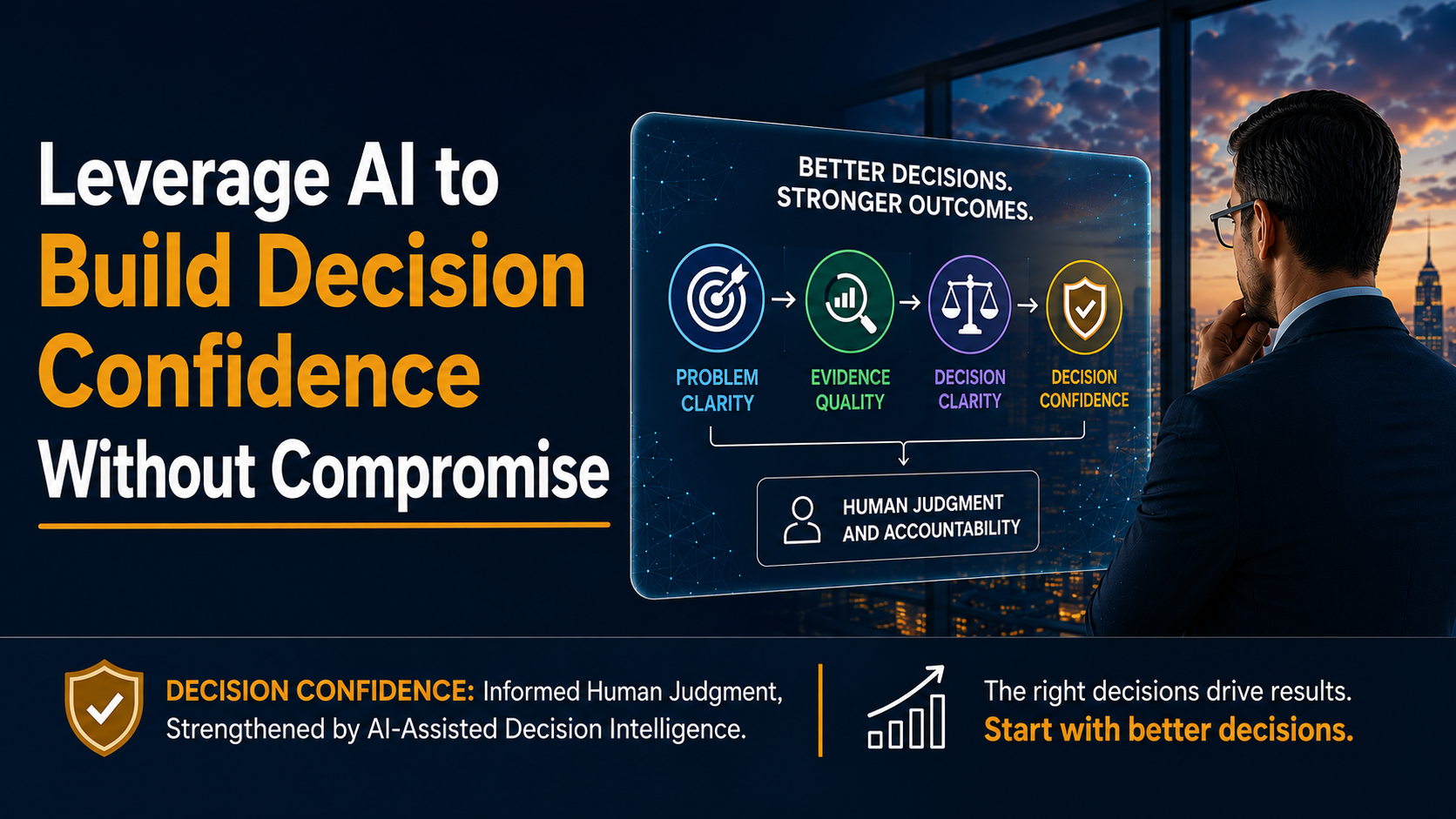
However, AI can help reduce unnecessary uncertainty by strengthening three critical elements of decision-making: Problem Clarity, Evidence Quality, and Decision Clarity.
When these elements are systematically strengthened, leaders are better equipped to exercise judgment, make well-informed decisions, and build greater Decision Confidence while retaining full accountability for the outcome.

Problem Clarity
Every strategic initiative begins with a decision to respond to a perceived problem or opportunity. Yet, the underlying problem is often poorly defined, misunderstood, or accepted without sufficient scrutiny. As a result, organizations risk solving symptoms rather than root causes, pursuing initiatives that fail to address the real issue, or committing resources to solutions that create little strategic value.
AI can strengthen problem clarity by organizing fragmented information, identifying patterns, synthesizing stakeholder perspectives, and transforming ambiguous ideas into a structured problem statement. It can also surface inconsistencies, expose assumptions, and reveal evidence gaps that might otherwise go unnoticed. This enables leaders to evaluate the problem from multiple perspectives before discussing potential solutions.
Problem clarity is important because it establishes a common understanding of what the organization is trying to solve and why it matters. Without that shared understanding, stakeholders may support the same initiative while pursuing entirely different objectives, resulting in misalignment, conflicting expectations, and poor investment decisions.
Problem clarity creates the foundation for every strategic decision that follows.
Evidence Quality
Decision confidence should never rest solely on a compelling presentation or persuasive narrative. Strategic initiatives are often supported by optimistic assumptions, selective data, or individual advocacy rather than comprehensive evidence. Without decision-quality evidence, leaders increase the risk of validating the proposed solution instead of objectively evaluating whether it deserves investment.
Strategic decisions require evidence from multiple perspectives, including organizational performance, customer needs, workforce insights, financial data, market conditions, historical outcomes, and emerging risks. No single source provides a complete picture. Confidence grows as evidence becomes broader, more credible, and more complete.
AI can significantly strengthen evidence quality by rapidly discovering, organizing, and synthesizing information from diverse sources. It can identify conflicting signals, expose evidence gaps, highlight emerging trends, and surface information that may not have been considered during traditional analysis.
Consider a leadership team evaluating a major workforce transformation initiative. One group may focus on employee survey results, another on budget projections, while others rely on customer feedback or operational performance metrics. Individually, each source tells only part of the story. AI can synthesize these perspectives into a more complete view, identify where conclusions conflict, and highlight areas requiring further validation before leaders commit significant resources.
Better evidence gives leaders a stronger foundation for making informed decisions with greater confidence.
Decision Clarity
Even when organizations have a clearly defined problem and strong evidence, decision-making can still become inconsistent. Different stakeholders often reach different conclusions because assumptions remain hidden, tradeoffs are poorly understood, or the reasoning behind a recommendation is difficult to explain. As a result, leaders may agree on the evidence but disagree on the decision.
AI can strengthen decision clarity by documenting assumptions, comparing alternatives, identifying potential risks, and providing an explainable rationale for recommendations. Rather than replacing human judgment, AI makes the reasoning behind a recommendation more transparent, enabling leaders to challenge assumptions, evaluate tradeoffs, and understand why one course of action may be more appropriate than another.
Decision clarity won’t eliminate disagreement. It will create a common understanding of the reasoning behind a decision, leading to more informed discussions and greater confidence in the decisions leaders ultimately make.
Building Decision Confidence
When problem clarity, evidence quality, and decision clarity improve, leaders gain greater confidence in their decisions. Not confidence based solely on intuition, but confidence built on structured reasoning, transparent evaluation, and evidence-informed judgment.
This is where AI can deliver its greatest value.
By strengthening problem clarity, improving the quality of evidence, and increasing transparency in decision-making, AI creates the conditions for leaders to exercise judgment more effectively. Rather than replacing human decision-makers, AI strengthens the quality of the information, reasoning, and evaluation that support strategic decisions.
Within the methodology described, decision confidence becomes the product of informed human judgment, strengthened by AI-assisted decision intelligence.
Human-Led. AI-Assisted.
The future of strategic decision-making will not belong to organizations that simply deploy AI to make standalone decisions. It will belong to organizations that thoughtfully integrate AI into disciplined decision-making while preserving human judgment, accountability, and responsibility.
Leadership remains human.
Judgment remains human.
Responsibility remains human.
AI serves as a decision intelligence capability that helps leaders think more clearly, evaluate more rigorously, and commit resources with greater confidence.
This philosophy is shaping my work on the Strategic Initiatives Decision (SID) System, an AI-assisted approach designed to strengthen decision confidence before organizations commit significant time, capital, and organizational effort.
Before organizations improve execution, they must first improve the quality of the decisions that determine what deserves to be executed.